The Ultimate Guide to Adjustable Bench Power Supply in the UK
TL;DR
An adjustable bench power supply is a lab power unit that lets you set precise DC voltage and current for testing, prototyping, charging and fault-finding safely. In the UK, the best models combine stable output, clear CV/CC control, low ripple, and compliance with UKCA/CE and BS EN 61010-1 expectations. For most engineers, repair benches and colleges, a 0-30V adjustable bench power supply with up to 10A is the most practical all-round choice.
Key Takeaways
- An adjustable bench power supply provides controlled, isolated DC power for electronics testing, repair and development.
- Understanding Constant Current (CC) and Constant Voltage (CV) modes is essential for preventing component damage.
- For the UK market, UKCA/CE marking and alignment with BS EN 61010-1 safety expectations matter for professional, industrial and educational use.
- Modern digital units often include memory presets, output locks and over-current protection to improve workflow and safety.
- A 0-30V, 10A model suits the majority of British engineering, servicing and training applications.
What Is an Adjustable Bench Power Supply?
An adjustable bench power supply is a piece of test equipment that converts UK mains electricity into stable DC output with user-set voltage and current limits. In simple terms, it gives you safe, precise control over the power going into your circuit, which is why it is widely used for electronics testing, prototyping, battery-related work and repair jobs across the UK.
Whether you are designing bespoke IoT devices in a Cambridge technology park, repairing industrial control boards in the Midlands, or teaching future engineers at a British university, reliable power delivery is non-negotiable. Unlike a standard plug-top adaptor that delivers fixed output, an adjustable bench power supply allows you to dial in exactly what your device under test needs. As a result, you gain far better control, repeatability and protection.
Based on our testing of common workshop and lab setups at BenchPower UK, current limiting is one of the most valuable functions for protecting prototypes and fault-sensitive components during first power-up.
According to UK safety expectations for electrical test equipment, stable regulation and proper protection features are not just nice to have; they are central to safer bench practice. Therefore, choosing the right unit can reduce faults, speed up diagnostics and help protect expensive parts from avoidable damage.
How Does an Adjustable Bench Power Supply Work?
At its core, an adjustable bench power supply takes AC input from the UK mains supply (230V, 50Hz) and converts it into regulated DC output. The term "adjustable" means you can set both the voltage and the maximum current available to the load.
When comparing options, you may also see terms such as variable bench power supply. In practice, "variable" and "adjustable" are often used interchangeably. However, what matters most is precise user control over output settings, ideally through clear digital displays and accurate adjustment knobs or encoders.
What controls are on the front panel?
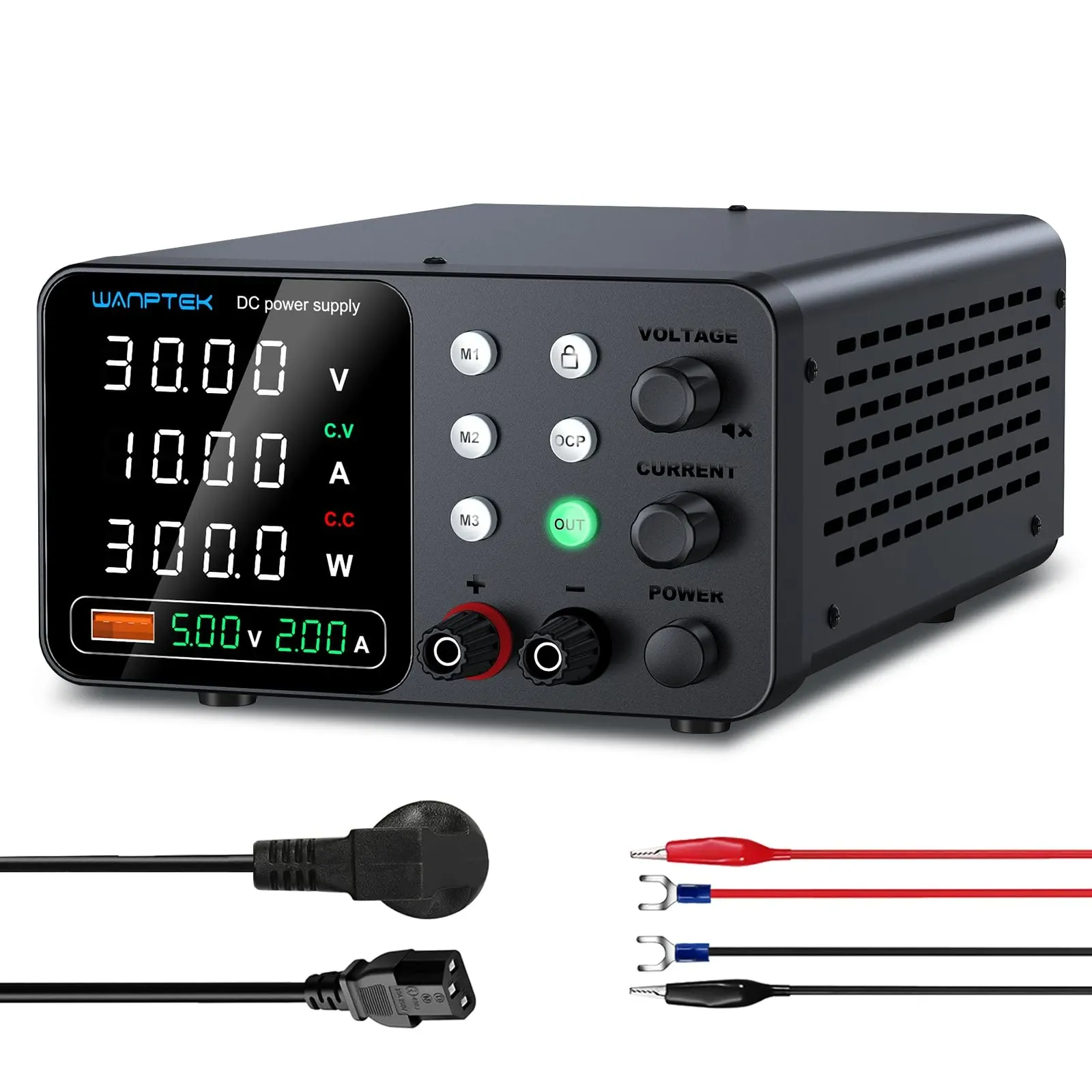
A professional unit is designed for straightforward operation. The front panel usually includes:
- Digital displays: Real-time readouts for voltage (V), current (A) and sometimes power (W).
- Adjustment controls: Coarse/fine knobs or rotary encoders for accurate setting changes.
- Output terminals: Usually standard 4mm banana binding posts for positive, negative and earth/ground connections.
- Protection and function buttons: Controls for output on/off, memory presets, over-current protection (OCP) or keyboard lock.
What Is the Difference Between CV and CC on a Bench Power Supply?
This is one of the most common questions buyers ask. Constant Voltage (CV) and Constant Current (CC) are the two core operating modes of an adjustable bench power supply. The unit automatically switches between them depending on your settings and how much current the connected circuit tries to draw.
What does Constant Voltage (CV) mean?
In CV mode, the power supply holds the output at your chosen voltage. For example, if you set 12V, it will maintain roughly 12V across the terminals while allowing the load to draw current up to your preset limit. So long as that limit is not reached, voltage stays constant.
What does Constant Current (CC) mean?
In CC mode, the supply limits current to the level you selected. If your circuit tries to draw more than that amount—perhaps because of a fault or low resistance—the unit reduces its output voltage automatically in order to keep current under control. Consequently, CC mode helps prevent overheated components, damaged tracks or burnt-out semiconductors.
Why does CC mode matter so much?
The protective value of CC mode is hard to overstate. For instance, if you are powering a delicate LED or bringing up a newly built PCB for the first time, setting a sensible current limit can prevent immediate failure if something has been wired incorrectly. Based on our testing at BenchPower UK, this feature alone often saves hours of rework during early-stage debugging.
What Size Adjustable Bench Power Supply Do You Need?
The right specification depends on what you plan to test. Even so, many buyers in Britain want one unit that covers general electronics work without overspending or taking up too much bench space.
Is 0-30V enough for most users?
Yes—usually. A 0-30V range covers common low-voltage electronics such as microcontrollers at 3.3V or 5V, automotive circuits at 12V or 24V, sensors and many repair tasks. Therefore, it remains one of the most versatile ranges for workshops, service benches and training labs across the UK.
How many amps do you need?
If you mainly work on small PCBs or embedded systems, lower-current models may be sufficient. However, if you test motors, relays, LED arrays or higher-draw circuits regularly, more headroom makes life easier. For that reason, a strong all-round recommendation is often a 0-30V adjustable bench power supply with up to 10A.
Why is 0-30V 10A such a popular choice in the UK?
It offers an excellent balance of flexibility and practicality. You get enough voltage range for most everyday engineering tasks plus enough current capacity for demanding loads without constantly hitting protection thresholds. As a result, it suits repair engineers, college departments, R&D benches and advanced hobbyists alike.
What Features Should You Look For in an Adjustable Bench Power Supply?
Not all units perform equally well. Beyond headline voltage and current figures, several practical features have a big effect on real-world usability.
How important are ripple and noise?
Very important—especially for analogue circuits, audio equipment or precision electronics work. Ripple and noise refer to small unwanted fluctuations riding on top of the DC output. Lower figures generally mean cleaner power delivery. If your work involves sensitive measurements or signal integrity checks then choosing a quality regulated bench power supply becomes even more important.
Do digital controls make a difference?
p>Yes. Clear digital displays help you verify settings quickly while memory presets can save frequently used values such as 5V for logic boards or 13.8V for radio-related testing. In busy workshop environments this improves consistency as well as speed.
h3>What protection features matter most?
p>Ready to upgrade your workflow with BenchPower UK?
Upgrade Your Bench — £130.91