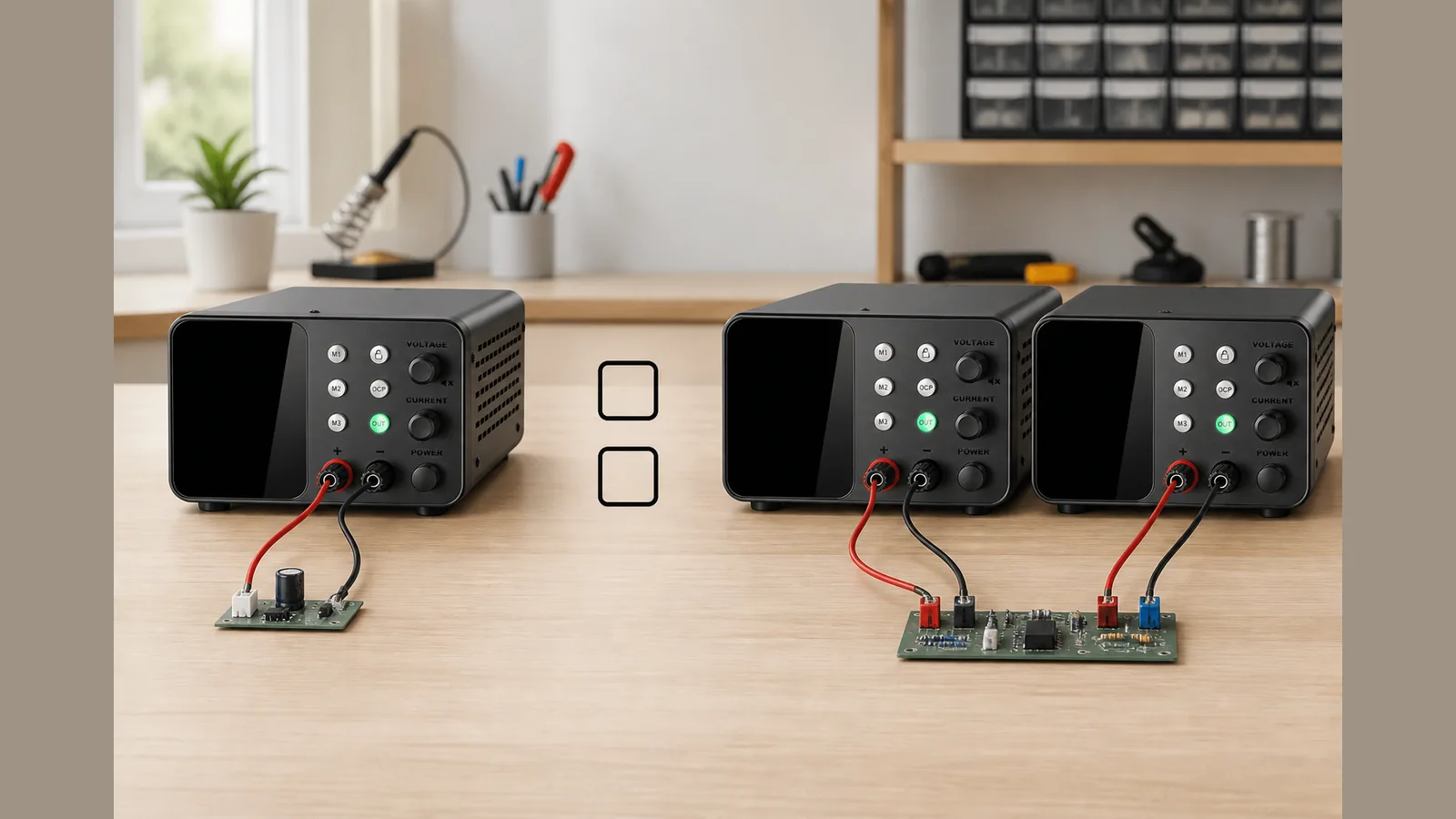
Single-Output vs Dual-Output Bench Power Supply: Buy for Your Circuits
Direct answer: one output suits one-rail work; independent multi-output work can justify extra channels
For a single output vs dual output bench power supply decision, choose one output when your work stays on a single rail, and consider extra channels only when you routinely need independent rails at the same time—after you confirm channel independence, isolation and control on the live product specification, not from assumptions.
List the rails and polarities your projects actually need
Before comparing instruments, write down what your boards and test fixtures really require:
- How many distinct voltage rails you energise in a typical session
- Whether any rail needs a different polarity or return arrangement
- Whether rails must change independently while others stay fixed
- Whether you ever need two or more sources on at once for one setup
That list, not a marketing label, decides how many controllable outputs you should buy.
Comparison table: bench space, simultaneous rails, isolation and control
At buying-decision level, multi-channel and single-channel options trade space and control differently. Industry application notes compare several single-channel instruments with one multi-channel supply for multi-rail circuits, stressing bench-space and independent-control considerations, and note that multi-channel supplies may have common or isolated outputs so independence must be checked before selection.
| Buying factor | Single-channel bench supply | Dual- or multi-channel supply |
|---|---|---|
| Bench space | One compact instrument for one-rail work; multi-rail work may mean several boxes | One chassis can cover simultaneous rails and free desk space |
| Simultaneous rails | Extra rails usually need extra instruments | Built for concurrent rails when channels are truly independent |
| Isolation | Separate instruments are often isolated from each other by design of separate boxes—still verify earthing and returns | Outputs may be common or isolated; confirm before you rely on them |
| Control | Simple one-rail set-and-measure workflow | Per-channel control only if the model provides it—verify on the specification |
See the Keithley note on multi-channel supply flexibility and the Tektronix guide to linear power supply specifications for why channel independence and isolation must be confirmed on the datasheet.
Do not assume channels can be combined
Never assume that outputs may be series- or parallel-connected, tracked, or treated as interchangeable rails. Combining channels without explicit manufacturer permission and ratings is unsafe and unsupported here. Treat each channel only as the product documentation allows, and treat every energised source as part of the electrical risk you must control in the test setup, as outlined in HSE guidance on safety in electrical testing at work.
When two simple supplies are more practical
Two (or more) simple single-channel units can be the clearer buy when:
- Most of your work is one-rail, and a second rail is occasional
- You want physically separate instruments for different benches or jobs
- You prefer not to depend on unconfirmed multi-channel isolation or control features
- You value straightforward single-channel purchase and setup over a denser chassis
When a dual or triple supply saves setup time
A dual- or triple-channel instrument can save setup time when you regularly power several rails together, want one footprint for multi-rail work, and have verified that each channel offers the independence and control your circuits need. If those conditions are not met, extra channels do not automatically improve your bench.
Buyer worksheet, who should not upgrade and FAQ
Buyer worksheet
- List every rail and polarity you use in a normal week.
- Mark which rails must run simultaneously.
- Note whether each rail needs independent set points and metering.
- Check the live product page for channel count, isolation and control—do not infer them.
- Confirm warranty and returns terms you care about before checkout.
Who should not upgrade
Skip a multi-output upgrade if your projects stay on one rail, if you cannot confirm independence or isolation on the live specification, or if you would only “combine” channels without manufacturer ratings. A confirmed 12-month warranty is useful cover, but it does not prove channel independence or combinability.
FAQ
Is a dual-channel supply always better for multi-rail boards?
No. It helps only when channels are independent in the way your circuit needs and when you have verified that on the specification.
Can I treat two outputs as one higher-capacity rail?
Not unless the manufacturer explicitly rates and permits that arrangement. Do not assume series or parallel use.
How many power supply outputs do I need?
Match the number of simultaneous, independently controlled rails in your real work—not a wish list of unused channels.
Where can I check the product before buying?
Review the current product details and verify channel-related claims on the live specification before you purchase.
Ready to compare options for your circuits? Open the current product details and confirm the live specification against your rail list before you buy.