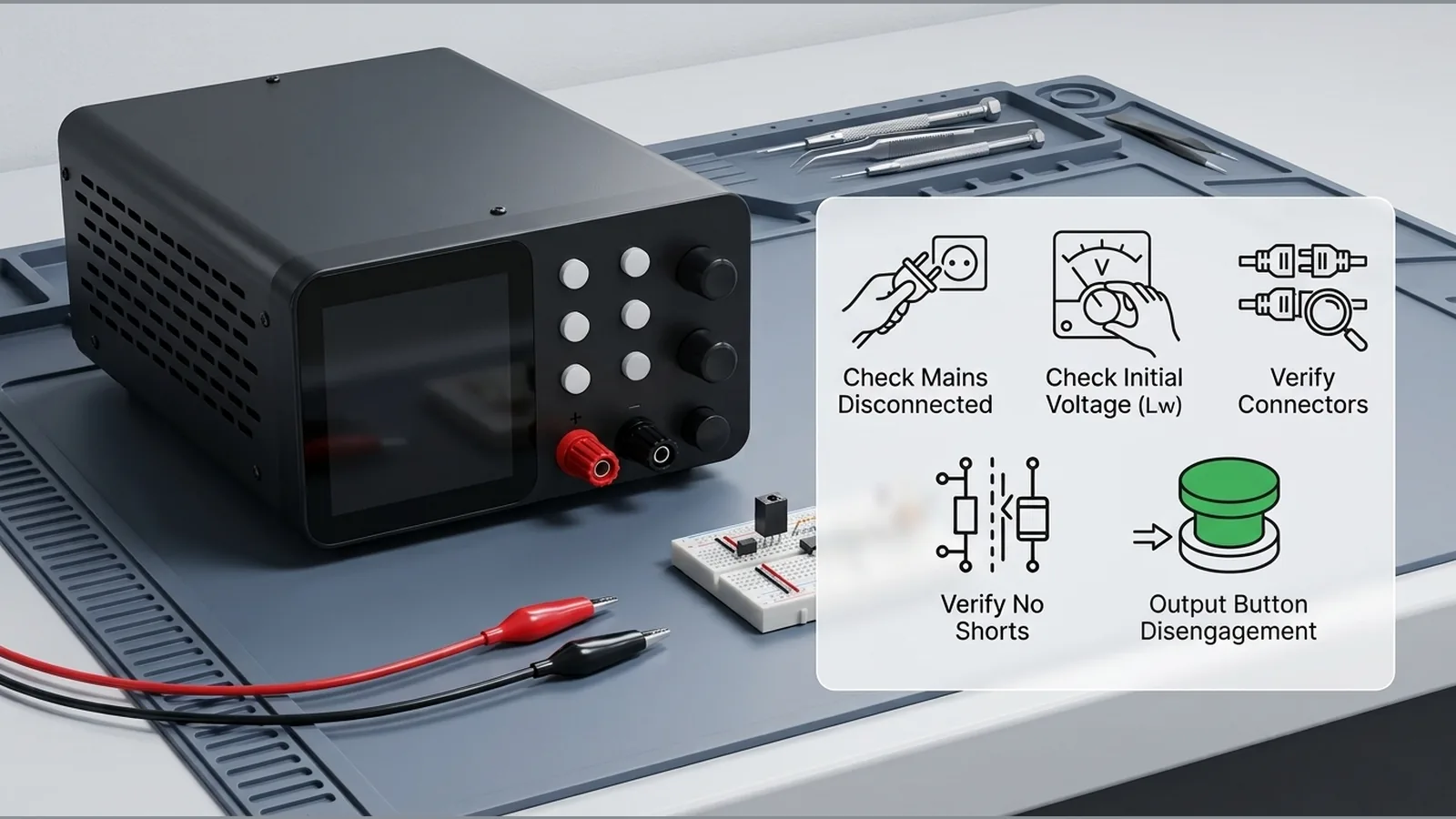
Bench Power Supply Safety Checklist UK: Before You Energise a Circuit
A practical bench power supply safety checklist UK starts with planning the test, confirming voltage, current, polarity and energy risks, inspecting leads and the device under test, then making all connections with the output disabled before you energise anything. Treat low-voltage DC work as controlled electrical testing: short-circuit, burn, battery and mains-input risks can still apply, so stay within competence and local risk controls.
Direct answer: plan the test and make connections with the output disabled
Before power is applied, write down what you intend to measure or prove, which rails or nodes will be live, and how you will isolate the supply if something goes wrong. Prepare every connection while the bench supply output is disabled or set so that no energy is delivered to the circuit. Only then raise the output under a controlled start. Verify the live product specification on the product page for controls and limits; do not assume features that are not confirmed there.
HSE guidance on safety in electrical testing at work covers risk control for diagnostic testing, fault finding and quality-assurance tests on low-voltage equipment, which is the right frame for a pre-start checklist rather than informal power-up habits.
Identify voltage, current, polarity and energy risks
Confirm the intended voltage and current limits for the device under test, and check polarity before any lead is attached. Note stored energy in capacitors, batteries or other sources that can remain hazardous after the supply is off. A low-voltage DC output does not remove short-circuit, burn, battery or mains-input risks at the instrument or the workbench.
- Match set limits to the circuit’s known requirements, then confirm details on the live product page.
- Mark positive and return paths clearly before connection.
- Account for batteries and charged parts that can feed energy back into leads or the supply.
Inspect leads, clips, terminals and the device under test
Visually check test leads, crocodile clips, banana plugs and binding posts for damaged insulation, exposed copper, loose strain relief or contaminated terminals. Inspect the device under test for obvious shorts, reverse-polarity risks, missing covers or unstable mechanical fixings. HSE states that electrical systems and test equipment must be safe and maintained, and that dead testing should be used where it is effective—inspection before energising supports that approach.
Set up adequate space, lighting and isolation
Clear the bench of clutter, give yourself adequate access to the supply, the circuit and the isolation method, and ensure lighting is good enough to see polarity markings and fine connections. Keep drinks, metallic tools and unused leads away from live terminals. HSE advises avoiding live working where possible, providing adequate access and lighting, maintaining test equipment and using competent people.
Connect before energising and keep exposed conductors controlled
Fit return and supply connections with the output still disabled. Keep unused conductors insulated or parked so they cannot bridge terminals. After connections are secure, enable the output and raise voltage or current in a controlled way while watching for heat, smell, unexpected current draw or wrong polarity symptoms. If the live specification does not confirm an output switch, output lock, over-current protection or isolated output, do not rely on those features—use the controls that are actually listed and your planned isolation method.
Stop conditions, emergency isolation and post-test shutdown
Decide stop conditions before you start: unexpected current rise, smoke, burning smell, wrong polarity indication, or loss of control of exposed conductors. Know how you will isolate the supply and how you will make the circuit safe. After the test, disable the output, discharge or isolate stored energy where required, disconnect leads deliberately, and leave the bench tidy for the next session.
Workplace competence boundary and FAQ
Workplace electrical testing must remain within competence and local risk controls. If the task involves unfamiliar mains-side work, fault finding beyond your training, or unclear isolation, stop and escalate to a competent person. For product choice and after-sales cover, the confirmed public warranty period is 12 months; check the current product details for the live specification rather than relying on secondary claims.
FAQ
Does a DC bench supply remove electrical risk?
No. Low-voltage DC still involves short-circuit, burn, battery and possible mains-input hazards. Plan connections with the output disabled and follow local safe working practices.
What should I verify on the product page?
Verify the live specification for any ratings, controls and accessories you intend to use. This article does not assert voltage, current, protection or interface claims beyond what you confirm there. The confirmed public warranty period is 12 months.
Where can I review the current product details?
Review the current product details for the Benchpower Pro 3010 before you buy or set up a test, and confirm the live specification against your checklist.
Ready to set up safely? Check the Benchpower Pro 3010 product details and confirm the live specification before you energise a circuit.